
Sports
20 Athletes Who Advocate for the Use of Cannabis in Sports
Some of the world’s best athlete use cannabis. Take a look at our list of the top 20 athletes who are leading the charge for the use of cannabis in sports.


As cannabis legalization marches forward, and the plant continues to be recognized for its numerous medicinal benefits, more athletes are coming forward to tell the world how it helps them heal or aids their training.
“Cannabis can be helpful for sports both during activity and afterward,” Dr. Tishler, a Harvard-trained physician, and cannabis therapeutics specialist, said to the Grow Op. “Its primary role is that of a pain reliever, which can be helpful in both situations.”
We’ve put together a list of 20 athletes — in no particular order — who advocate legalizing cannabis and champion its use as part of their recovery and training.
Eugene Monroe

In March 2016, Monroe became the first active National Football League (NFL) player to openly advocate for cannabis use to treat sports-related injury and chronic pain. In a “New York Times” piece published in May of that year, Monroe called on the NFL and its commissioner, Roger Goodell, to stop testing players for cannabis. He cited its potential as a safe alternative to other, commonly prescribed medications like opioids:
“We now know that these drugs are not as safe as doctors thought, causing higher rates of addiction, causing death all around our country,” Monroe told the publication, “and we have cannabis, which is far healthier, far less addictive and, quite frankly, can be better in managing pain.”
The former offensive lineman spent seven years in the NFL. He played for the Jacksonville Jaguars (2009-2013), and Baltimore Ravens (2013-2016) before he retired in June 2016 to focus on his health and family.
He’s dedicated his post-NFL career to raising awareness about the medicinal benefits of cannabis. He publicly urges the NFL on his website “[…] to remove marijuana from the banned substance list; fund medical marijuana research, especially as it relates to CTE; and stop overprescribing addictive and harmful opioids.”
Monroe is a member of HealthyUNow, Athletes for CARE, and Green Thumb Industries (GTI), a research, cultivation and dispensary facility.
Liz Carmouche

Carmouche, aka the “Girl-illa” was one of the first females to introduce mixed martial arts (MMA) to the Ultimate Fighting Championship (UFC) when she competed against Ronda Rousey in 2013 for the organization’s inaugural women’s title fight. Carmouche is credited as the first openly gay female to compete inside the famous cage. She uses CBD to heal faster and to train harder.
CBD oil is her saving grace after hours of intense practice. Carmouche told “Cannabis Aficionado” in December 2018 that she applies topicals and salves immediately after workouts to relieve pain and inflammation.
“[Combat athletes] take so much impact and destruction to our bodies,” she said, “We need to find something to take care.” With little to no known side-effects, CBD is a safe and effective way to do that.
The benefits she experiences from CBD inspire her to promote its use among elite athletes and average Joes. In fact, Carmouche said she doesn’t understand why someone wouldn’t use CBD. It’s “not only safe to use during intense physical activities, but is non-addictive and won’t get you high,” Carmouche said in a HempMeds announcement, “There’s just a lot of misinformation out there and I’d love to help clear that up.”
Carmouche is an advocate for the LGBTQ community; she is also a veteran of the U.S. Marine Corps. She’s currently partnered with the hemp oil company, HempMeds.
Ricky Williams
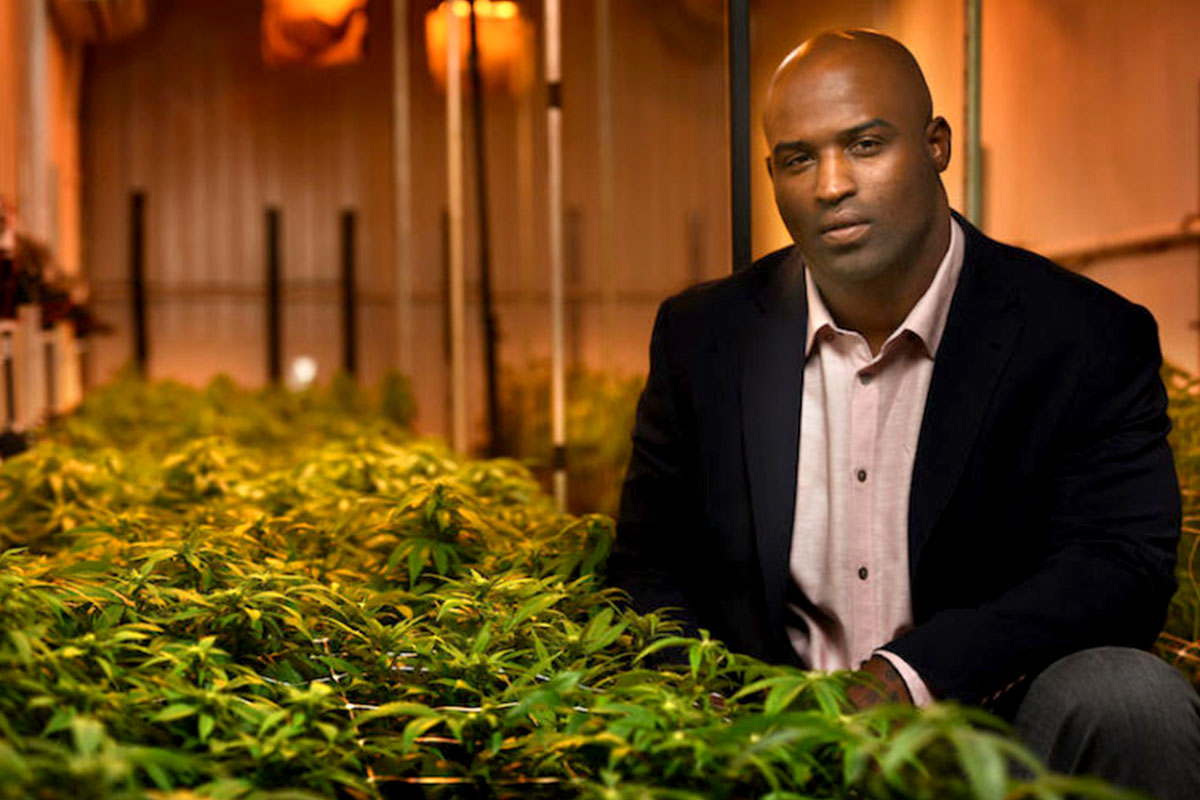
Since leaving the NFL, Ricky Williams has studied herbalism and alternative holistic therapies. Williams was suspended multiple times during his NFL career for his cannabis use but has spoken repeatedly about the benefits and effects of the plant.
Former running back Williams, who won a Heisman Trophy at Texas before spending more than a decade in the NFL with the Miami Dolphins and New Orleans Saints, has founded Real Wellness by Ricky Williams; a new line of cannabis-based products that also feature herbal extracts like lavender and turmeric.
The Diaz Brothers

The Diaz brothers are unabashed cannabis users – and have been for a least a decade. The MMA fighters are known to vape immediately after fights, and before the cameras during press conferences. Their famous affinity for the plant landed the brothers on Rolling Stone’s 2017 list of the “Biggest Stoners in Sports. “ It’s also landed them in hot water with the UFC.
Nate and Nick have both faced fines, and risked suspension for cannabis use. Nick regained his ability to compete in 2018, and according to ESPN, will return to competition this year.
In the meantime, the Diaz brothers continue to use their platform to fight the stigma surrounding the plant. They’ve built several partnerships and launched GameUp, a CBD-infused, plant-based super nutrition company.
Floyd Landis

Landis is a former road racing cyclist. He was thought to be the winner of the 2006 Tour De France, but he tested positive for performance-enhancing drugs. He later “blew the whistle on other cyclists involved in using performance enhancers,” reported Bicycling.com.
Now, Landis is “happy to be involved in a legitimate industry,” he quipped on a Twitter post. He founded Floyd’s of Leadville, a company that produces CBD products intended to ease pain and inflammation.
In a 2016 interview, Landis said, “For years I relied on opioid pain relievers to treat my hip pain. With cannabis, I find that I can manage my pain and have a better quality of life. We need to give people a safer alternative.”
Nate Jackson

Jackson played in the NFL as a tight end from 2002-2009. He detailed he experience in the league in a Los Angeles Times’ Op-ed piece: “Until I made it to the pros, I didn’t take opioids,” Jackson said. He had no interest in taking pills, but was given them anyway. He was prescribed a series of medications, but by 2007, he stopped using all of them — except cannabis.
“By the time I tore my groin off the bone, in 2007, I was medicating only with cannabis,” he wrote. “The team doctors cheered the speed at which I was healing, but I couldn’t disclose to them all that I was experiencing — no pain, no inflammation, restful sleep, vigorous appetite, a clear head.” Jackson said that despite these results, he — and others — “had to remain generally mum about cannabis.”
Now, Jackson is outspoken about the benefits of cannabis for athletes, and for veterans. He’s a member of Athletes for CARE, and co-hosts the “Caveman Poet Society Podcast” (formally the “Mindful Warrior Podcast”).
Amy Van Dyken

Van Dyken is a six-time Olympic gold medal-winning swimmer. She suffered an ATV accident in 2014, which left her paralyzed from the waist down.
Van Dyken credits CBD from hemp for allowing her to manage neuropathic pain, and live a normal life. She told Civilized in August 2018: “I cannot live without it, and I will not live without it.”
The Olympic gold medalist announced her partnership with Kannaway, a hemp lifestyle network, in 2018. In a press release from the company, she said that she advocates for Kannaway’s CBD products because they’ve drastically improved her quality of life: “I hope my story can help spread awareness of the benefits of CBD so that people like me can feel more comfortable giving it a try.”
Riley Cote

Cote is a former professional ice hockey player and coach. He spent eight years in the National Hockey League (NHL) as a left-winger where he became known as the “enforcer.”
He discovered the therapeutic benefits of cannabis at an early age from his sister, who used it to treat symptoms of multiple sclerosis (MS). Cote used it to treat pain, ease pre-game anxiety, recover quicker, and to minimize the need for pharmaceuticals throughout his career in the NHL.
After his retirement in 2010, Cote founded the HempHeals Foundation, and co-founded Athletes for CARE.
Eben Britton

The offensive lineman played six seasons with teams including the Jacksonville Jaguars and Chicago Bears. The former NFL player leads the growing list of players who are advocate cannabis’ removal from the league’s list of banned substances.
In an interview with HelloMd, Britton described cannabis as mentally and physically replenishing. It brings him into a peaceful state of mind, eases pain, and helps him sleep.
Britton co-founded Athletes for Care alongside Nate Jackson. The non-profit organization supports research and education and encourages athletes of all levels to use their platform to improve global health. He also hosts the “Caveman Poet Society” podcast and is the founder Be Tru Organics.
Dee Dussault

Dussault is a ganja yoga extraordinaire. She is credited as the first teacher to publically offer cannabis-infused yoga classes in the U.S. and Canada.
She isn’t the first to combine the two; the practice goes back millennia. But, it was Dussault who brought ganja yoga from her living room in Toronto to mainstream studios throughout North America. Now, the fitness trend is everywhere.
Enhancing exercise routines like yoga with cannabis decreases stress and increases focus and relaxation. In an interview with The Emerald Magazine in 2017, Dussault said that separately, both yoga and cannabis are shown to aid in pain management and anti-inflammation. “Combining the two enhances the effects of each,” she added. It also helps people “explore what their body can do – allowing for creative and expressive movement,” said Dussault.
Dussault offers a series of ganja yoga classes, from New York City to L.A. She’s also the author of “Ganja Yoga.” She’s also a certified sex therapist.
Jim McAlpine

Jim McAlpine is proof that stoners are not lazy. The natural born athlete and entrepreneur founded a series of sports companies and events, including Snowbomb.com, and Snowbomb Ski and Snowboard Festivals. In 2014, he founded the 420 Games, a nationwide athletic competition for cannabis enthusiasts.
McAlpine has always led an active lifestyle. Like many, he uses cannabis to enhance workouts, and aid in recovery.
He told Cannabis Now that in 2015, he swam a mile and a half from the San Francisco Bay to Alcatraz after ingesting an edible. Eating half of an infused Kiva bar, he said, was the only way he could survive the cold waters, and long swim.
In an interview with “PRØHBTD”, McAlpine said, “A picture is worth a thousand words, but athleticism is worth a million words. You can’t refute Ricky Williams was the best, right? You can’t refute Michael Phelps was the fastest man ever in the water or Usain Bolt the fastest man ever on land, and they’re both cannabis enthusiasts. There’s a [meme] of Michael Phelps with his 12 or 15 gold medals that says, ‘Winners don’t smoke weed, champions do.’”
McAlpine is also the founder of the New West Summit and co-founded Power Plant Fitness, a cannabis-friendly gym set to open in 2019.
Andrew Talansky

The former elite cyclist and current triathlete spends hours training every day. He said his body is constantly inflamed, and his muscle are always sore. He told “Outside” magazine that he turned to CBD after he strained a hip flexor.
“I took it for a couple of weeks, and there was a noticeable difference immediately,” Talansky told the publication, “And it wasn’t just that my hip was feeling better. I was less anxious, and I was sleeping better.”
Talansky regularly speaks about his experience with CBD. He told “Runner’s World” it helps him recover faster, and have fewer flare-ups. That’s why he’s on a mission to encourage other athletes to try CBD, and rid it of negative stigma.
Brian Kaho

Kaho has been a serious athlete since the age of 13. He was a wrestler and an award-winning football player in high school. But, his plans for an athletic career were put on hold when he suffered a torn meniscus.
Kaho weighed 270 pounds when he graduated high school in 2003. He was tired of carrying the football weight. He started running and using cannabis to enhance his workouts.
Now, with a degree in communication from San Jose State University, Kaho works to educate others about cannabis as a conduit to health and fitness. The personal trainer’s method pairs certain breathing techniques with workout routines. Cannabis, he told “Runner’s World Magazine,” “can do wonders to help one focus on the most crucial part of working out: breathing.”
Kaho has appeared at the 420 Games and is reported to work with Power Plant Fitness when it launches later this year. In the meantime, Kaho continues to coach athletes, and promote green workouts via social media.
Kyle Turley

Cannabis saved Turley’s life; he’s been outspoken about that very fact since retiring from the NFL in 2007. The former pro football player spent eight years as an offensive lineman for teams including The St. Louis Rams and the New Orleans Saints. Like many former NFL players, his career left him with physical and mental scars.
Turley speaks publicly about his struggle with chronic traumatic encephalopathy (CTE). Cannabis helps him manage chronic pain and neurological issues including depression, seizures, and dementia.
Turley continues to raise awareness about the medicinal value of cannabis — especially in the treatment of sport-related injuries and CTE. He sits on the board of Gridiron Greats, a nonprofit that provides care to former NFL players in need. Turley also helped found Neuro XPF, a hemp-derived cannabis supplement.
Greta Gaines

Gaines is a former professional fly-fisher and extreme snowboarder. She became the first female champion snowboarder, and the only woman to compete in the World Extreme Snowboarding Championship in 1992.
She explained to NORML Athletics in 2015 that cannabis is part of extreme snowboarding culture. The athlete would use it mostly for recreation, or to ease anxiety before adventures (like jumping out of a helicopter onto the slopes). These days Gaines uses it to manage pain associated with arthritis.
Gaines founded The Hempery, a hemp-based skincare line. She is also an active member of Women Grow.
Frank Shamrock

Shamrock is a former MMA fighter, and undefeated UFC Middleweight champion. He uses cannabis to treat injuries incurred during his 16-year competitive fighting career.
He’s used cannabis since he was a kid, and throughout his career, telling High Times, “I used cannabis during my entire sports career, from day one until the very end. I used to recover, I used it for pain, I used oils to protect my brain.”
Shamrock co-hosted The BakeOut Show, a talk show aimed to educate the mainstream audience about cannabis. He’s a member of Athletes for Care, and regularly speaks at events including the World Medical Cannabis Conference and Expo.
Cliff Robinson

Robinson is a longtime cannabis consumer. The former NBA all-star played 18 seasons in the National Basketball Association (NBA) for teams including the Portland Trailblazers and the Phoenix Suns.
According to Yahoo Sports, “Robinson twice faced marijuana charges from police during his playing career and thrice was suspended for violations of the NBA’s substance-abuse policy.”
Robinson is dedicated to raising awareness of the racial injustice and disparities created by the War on Drugs. He regularly lobbies in favor of cannabis legalization. He is a member of the Coalition to Regulate Marijuana in Connecticut. He is also the founder of Uncle Spliffy.
Julie Anthony

Anthony is a former world-class tennis player. She played for Stanford and helped establish World Team Tennis in 1974, according to the Intercollegiate Tennis Association (ITA) Hall of Fame. While on the professional circuit, the ITA added, Anthony earned a doctorate in clinical psychology.
“From 1989 to 1994 she coached doubles player Gigi Fernandez to 11 Grand Slam titles and an Olympic gold medal. Anthony was the owner of the Aspen Club and founder and director of its Fitness and Sports Medicine Institute 1982-1995,” according to Athletes for Care.
Anthony nows works as a sports psychologist. She is a member of Athletes for Care, and has appeared on shows including the “Caveman Poet Society.”
Ross Rebagliati

The former Canadian snowboarder won an Olympic gold medal in 1998, but it was briefly revoked after THC was found in his system. In a strange turn of events, his gold medal was returned to him after the Olympic Committee admitted that cannabis was not included on their list of banned substances.
The case made him a household name and brought cannabis into the spotlight. At the end of 2018, Rebagliati told “The New York Times” that he hopes Canada’s decision to legalize cannabis will provide him with closure, and economic opportunity.
Rebagliati recently founded Legacy, a cannabis lifestyle brand. “I am finally reclaiming my marijuana legacy,” he told the Times of the company’s namesake.
Avery Collins

Collins is an ultramarathoner. He runs in competitions that range from 50-200 miles per day. While a typical ultramarathon consists of running 26 miles or more, Collins definition is more intense. “Ultra-running for me is that 50- to 200-mile distance in mountain environments and mountain terrain,” he told Leafly, “Lots of vertical gain, and technical, rocky, really gnarly trails—it has to be the ultimate challenge. I don’t really see the point in running 50 miles across a flat road.”
Sometimes, he said, he could be running for 28 hours. His secret is cannabis, which he began consuming before he became a runner.
Collins is sponsored by The Farm Marijuana Dispensary. According to SB Nation, Collins is the only endurance runner that’s sponsored by a cannabis company.
Special Mentions
Katina Morales
Katina Morales is the owner and creator of Betty Khronic, a line of vegan energy bars. She is also an athlete. Morales became a long-distance runner at the age of 17. She only ever used cannabis to aid her recovery.
Morales lost her graduate position at the University of Southern Florida, and her job at the National Collegiate Athletic Association (NCAA) where she was preparing to become a coach. She was fired after a photo of her holding a bong surfaced online.
The experienced forced her to find another path. So, she started making edibles, and eventually launched Betty Khronic. Morales, who still runs, now helps other athletes incorporate cannabis into their healthy lifestyle through her line of infused energy bars.
Greg Horton
Horton is the founder of The Casual Athlete, based in Ontario, Canada. The personal trainer provides fitness solutions for people of all abilities. He believes cannabis to be an important tool for anyone looking to achieve mental and physical health and wellness.
In an interview with “The Emerald Magazine,” Horton said he does not want people to think only of able-bodied people when thinking of cannabis: “I cannot underline enough the usefulness of cannabis to help otherwise severely disabled persons… be able,” he told the publication.
Remember, winners don’t use cannabis, champions do.



Sports
UFC 334 Brings Two Title Fights to New York—and a Separate Cannabis Fitness Question
Two championship fights lead UFC 334 at Madison Square Garden tonight. For cannabis readers, ringside fitness guidance is a separate issue from the fight card.
Sports
Philadelphia Marathon Preparations Put Cannabis and CBD Rule Questions in Focus
Philadelphia expects its largest marathon weekend field November 20–22. Event preparation and anti-doping cannabinoid rules answer different questions.
Sports
MEDICA Puts Cannabis Counseling on the Sports Pharmacy Agenda
MEDICA’s November 16 sports pharmacy symposium includes a cannabis counseling workshop, alongside anti-doping and supplement discussions.
-

 Cannabis4 weeks ago
New Jersey Hemp Drink Extension and Retail Penalties Advance
-

 Cannabis3 weeks ago
DEA Judge Keeps Cannabis Hearing Closed but Adds a New Briefing Round
-

 Cannabis4 weeks ago
Cronos Completes CanAdelaar Deal in the Dutch Cannabis Pilot
-

 Cannabis4 weeks ago
Seed Junky’s Trulieve Deal Opens a New Chapter in Pennsylvania
-
 Cannabis4 weeks ago
Tilray Brings Cannabis Quality Testing In-House in Portugal
-

 Cannabis4 weeks ago
New York Opens Cannabis Nursery Applications November 5
-

 Cannabis3 weeks ago
North Carolina’s Cannabis Debate Turns to Who Would Run the Stores
-

 Cannabis4 weeks ago
SNDL Expands Its Indirect Stake in Parallel