Idaho voters face a cannabis question on November 3 that is less about opening dispensaries than deciding who gets to write the rules. House Joint Resolution 4 would put exclusive authority over legalization in the Legislature’s hands, closing a route that cannabis reform supporters could otherwise pursue through citizen initiatives.
The distinction matters on Election Day: voting against HJR 4 would not itself legalize marijuana. Voting for it would change the state’s constitutional allocation of power. For cannabis readers following the next possible reform campaign, the consequential issue is whether voters can still bypass lawmakers to propose a legalization statute.
What yes and no would mean
The Idaho secretary of state’s official explanation says approval would reserve legalization authority for the Legislature and remove citizens’ ability to initiate statutes legalizing the covered substances. Rejection would preserve the existing initiative pathway. The proposal also addresses narcotics and other psychoactive substances, so its scope extends beyond cannabis.
Think of the vote as a decision about the doorway, rather than the policy that might eventually pass through it. A future proposal would still need its own specific rules, supporters and votes. Keeping a route available does not mean that a particular proposal has qualified or that a legal retail market is about to begin.
That is also why a headline describing this simply as an Idaho marijuana legalization vote would miss the central choice. Voters are being asked whether exclusive authority should rest with elected lawmakers, not whether a particular possession limit, licensing system or medical program should take effect.
The cannabis initiatives are not on this ballot
The same official state page lists both the Idaho Medical Cannabis Act and Decriminalize Cannabis Now as initiatives that did not qualify. Neither should be confused with HJR 4. Their absence and the constitutional amendment’s presence are separate facts, even though all three belong to the broader debate over cannabis policy.
For readers seeing campaign messages about patient access or criminal penalties, the useful follow-up is to identify which document the message concerns. An argument for medical cannabis is not an explanation of the amendment’s legal mechanism. Likewise, a position on the initiative process does not necessarily disclose someone’s position on every possible future cannabis bill.
Why the initiative route takes work
Idaho’s official filing requirements outline a multistep process involving review, ballot titles, circulation and county signature verification. That machinery matters because access to the ballot is a substantial undertaking even when the constitutional route remains available. Campaign enthusiasm alone is not qualification.
The state says circulation is limited to an 18-month period or April 30 of the election year, whichever comes first. County clerks verify signatures against qualified-elector records. Those procedural hurdles help explain the distance between announcing a cannabis initiative and giving voters an actual measure to decide.
The practical difference between the two HJR 4 outcomes therefore lies upstream of any future legalization vote. Under one outcome, a campaign could try to navigate the initiative process; under the other, it would need to focus on legislative action for legalization. Neither route guarantees political success.
A question about political authority
The independent Idaho Voters guide reproduces the proposed constitutional language and distinguishes the amendment from existing statutes. Its account traces the measure to legislative action in 2025. This is a proposal lawmakers referred to voters, rather than a citizen legalization petition that reached the ballot through signatures.
For the cannabis industry, the lesson is to separate legal access, political process and commercial opportunity. A constitutional result is not a license announcement. Businesses cannot responsibly treat an outcome as permission to sell, and consumers should not interpret a rejected amendment as a new right to possess or purchase cannabis.
Where to follow the result
The official general-election page provides the state’s results link and election information. Statewide results begin after Idaho’s last polls close, listed as 8 p.m. Pacific and 9 p.m. Mountain. That reporting timetable is distinct from a declaration that every ballot has been counted or a result certified.
This article is an Election Day explanation, not a report of the outcome. When returns arrive, the meaningful next update will pair the vote with the actual legal consequence. Until then, the clearest reading remains the simplest: HJR 4 concerns who may authorize legalization, while neither choice immediately creates a legal cannabis market.
One useful comparison is the distinction between qualifying a proposal and winning a vote. An initiative can fail before Election Day because it never reaches the ballot; HJR 4 instead asks voters to change the availability of that route for future legalization efforts.
For a different ballot-policy question, see our Massachusetts Question 8 poll coverage. That measure concerns an existing retail system; Idaho’s amendment instead concerns authority over future legalization.
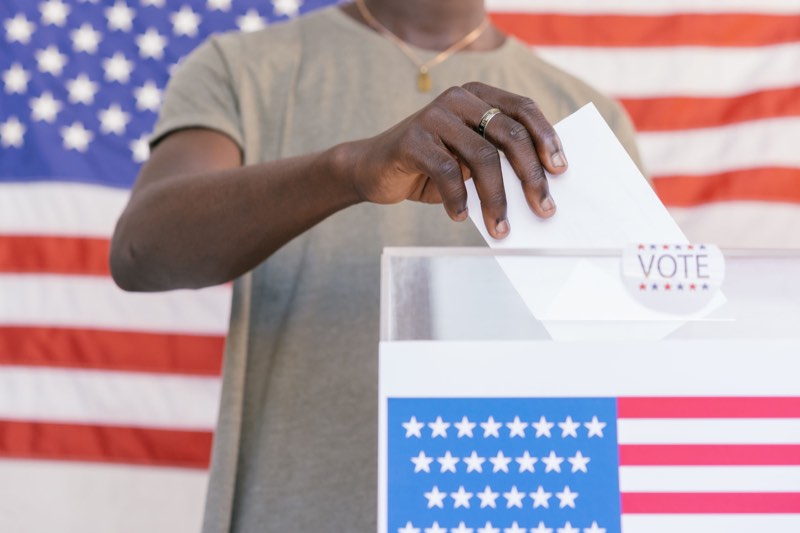
Illustrative voting photograph; not an Idaho polling place. Photo: Mikhail Nilov / Pexels.










 Cannabis1 month ago

 Cannabis1 month ago
 Cannabis1 month ago
 Cannabis1 month ago


 Cannabis1 month ago

 Cannabis1 month ago

 Cannabis4 weeks ago